
One national pool for incompatible donor–recipient pairs, built by the Indian Society of Organ Transplantation.
Most people who reach a transplant centre with a living donor arrive with a family member who has already decided. The obstacle is rarely willingness. It is that this particular donor cannot give to this particular patient — the blood groups do not work, or the patient carries antibody against the donor's tissue type.
Nothing about that donor is unsuitable. They are unsuitable for one person. Somewhere there is a patient for whom they are exactly right, and that patient very often has a donor who is exactly right for the first.
A swap registry is the machinery for finding those pairs. Two pairs cross over; where a straight crossover will not close, three, five or fifteen pairs form a ring in which every donor gives and every patient receives.
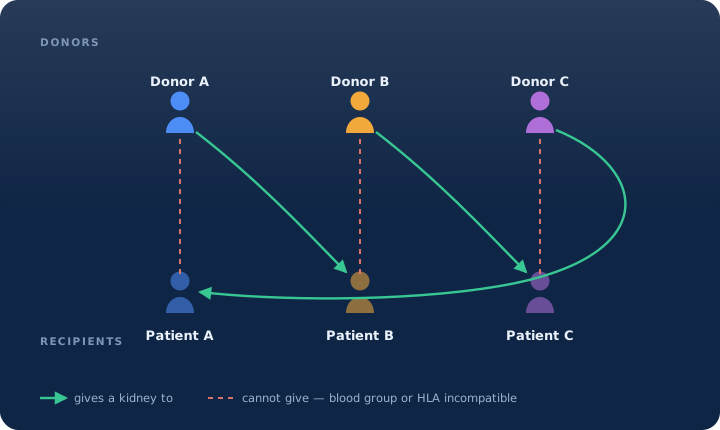
The chance of resolving an incompatible pair rises with the number of pairs it can be compared against. A centre searching only its own list is searching the smallest pool available to it.
A highly sensitised patient may be incompatible with almost every donor they are shown. Their match exists, but the odds of it sitting in the same building are poor.
A three-way exchange needs three compatible pairs simultaneously. A fifteen-way needs fifteen. Cycles of that length only appear in a pool large enough to contain them.
Typing, antibody panels and clinical data recorded the same way at every centre — so a pair can be assessed by another team without a phone call and a re-typed spreadsheet.
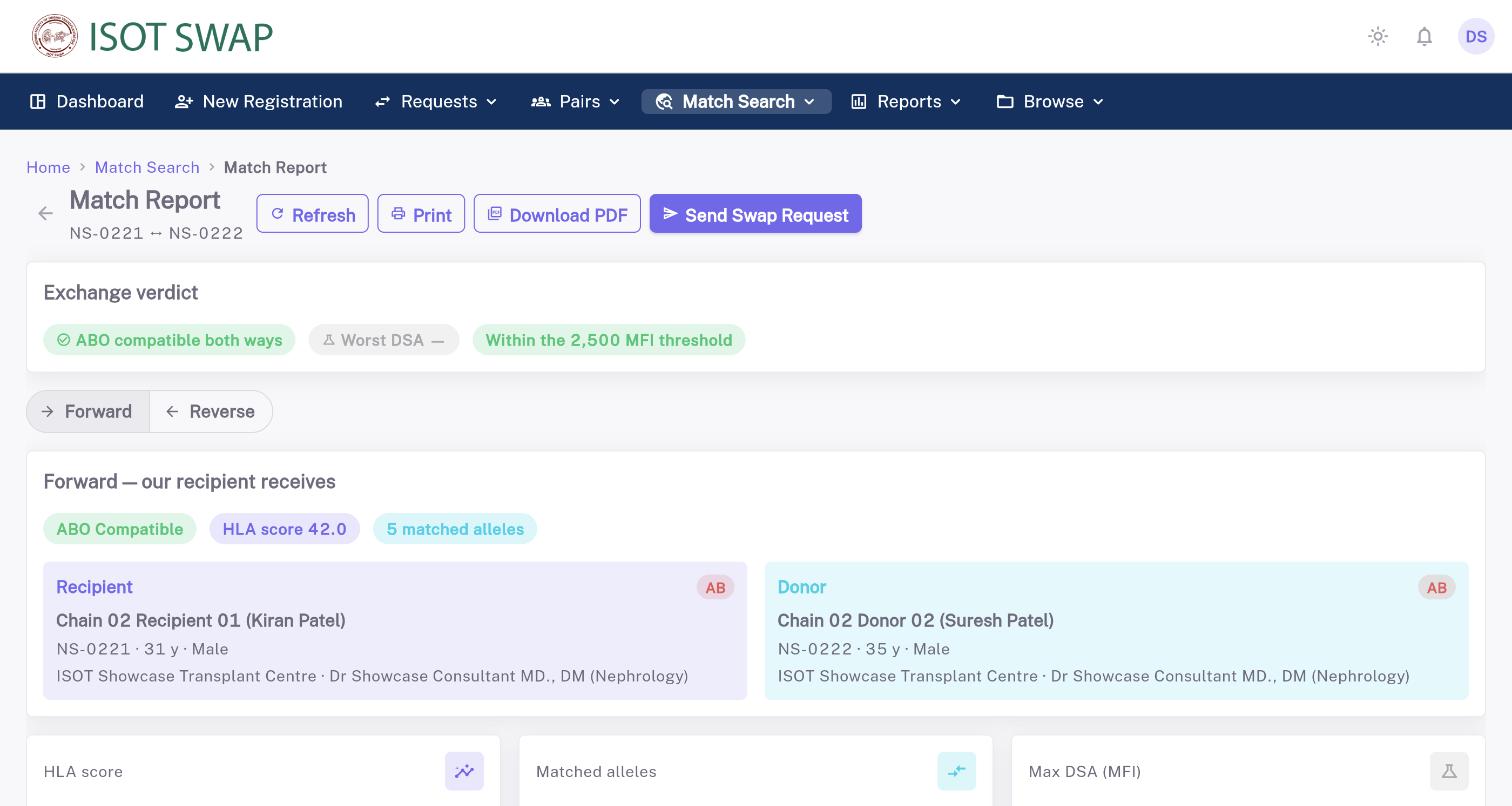
Centres register incompatible pairs with full demographics, medical history, serology, HLA typing and a single antigen bead panel. The engine then assesses every possible pairing on six layers — blood group, weighted HLA score, donor-specific antibody, unacceptable antigens, eplet mismatch and CREG — separately in each direction, because compatibility is not symmetric.
What comes out is not a yes or a no. It is a report: the verdict, the arithmetic behind it, and the specific antibody or antigen that decided it, for two consultants to read and judge.
Swap requests, acceptances and declines are recorded, and the numbers that were true at the moment a request was sent are stored with it — so a decision can be reconstructed later, not merely remembered.
Worth stating as plainly as what it does.
Statutory approvals, authorisation committee clearance and donor consent are unchanged and remain the responsibility of the transplanting centres. A match report is a clinical document, not a permission.
The virtual crossmatch is a screen run against the recorded antibody panel. Your laboratory's physical crossmatch before transplant is unaffected.
Thresholds are adjustable per search, eplet and CREG analysis ranks rather than excludes, and every proposed exchange has to be accepted by both centres before anything happens.
The 2,500 and 1,500 MFI thresholds are this registry's policy, not a standard, and the site says so. MFI is semi-quantitative — prozone, bead density and lot-to-lot drift all move it — and it is not a titre. There is no evidence base for eplet-guided paired exchange in any population, so eplet load ranks candidates and excludes nobody.
Every antibody check compares the recipient's antibodies against the donor's alleles. With no donor typing there is nothing to compare against — so an untyped donor is excluded from matching rather than reported as a negative crossmatch. The safe answer to a question you cannot ask is not "acceptable".
Another centre sees what it needs to judge an exchange and not the patient's name, consultant or hospital, until a request is accepted. Clinical data is never redacted, because assessing viability against hidden values is not possible.
Where the software is incomplete, this site names it rather than leaving a gap for the reader to fill in optimistically. ABHA identifiers are recorded and validated but not yet exchanged over the ABDM network, and the FAQ says so in those words.
ISOT SWAP is the society's swap transplant registry, covering kidney and liver. A transplant consultant registers and submits their centre's transplant licence; the licence is verified, the centre is enrolled alongside them, and their transplant coordinators are added afterwards. How registration works →
Correspondence about the registry goes to the Honorary Secretary.
Thirty-three answers on HLA scoring, MFI thresholds, the virtual crossmatch, eplet and CREG analysis, chain length, privacy and consent. Read the FAQ →
How registration works, what data is mandatory, and the document checklist for a donor workup. Open Resources →
Register as a consultant, or sign in if you are already enrolled. Register → · Sign in →
Every incompatible pair added to the national pool improves the odds for every other pair in it — including yours.